
"Urban Memory: How to do things with cities" – Vlora

1st Day
Institute for Democracy, Media & Culture (IDMC) in collaboration with Vlora Youth Centre organized on 3‒5 February 2017 "Urban Memory: How to Do Things with Cities", a series of workshops planned in Vlora, Korca and Tirana.
On Day 1 in Vlora, the workshop directors introduced the core concepts for the weekend and why they were committed to explore specific subjects. The day began with a reading from Michel Butor's Mobile. The text served as a rich example of experiment in form, perspective, and observation. After a brief discussion, the trainers outlined what was expected of each participant: a collaboratively-written text in first person, inspired by a city, developed over the course of the weekend. They went through a set of images participants had submitted in advance, asking each one to describe their selection and the meaning they wanted to convey. After a short break, the participants and the trainers reconvened and the group was split into pairs.


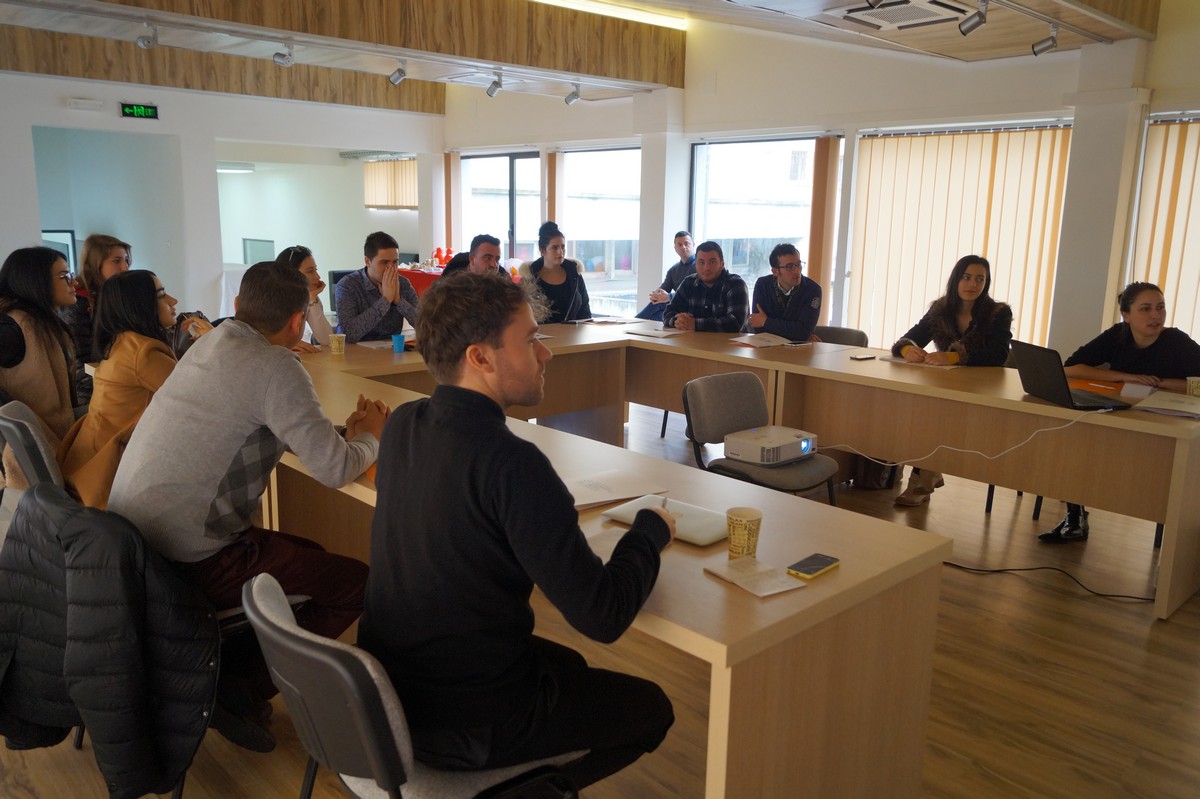


The participants were handed two notebooks to demonstrate a technique used by the journalist Ryszard Kapuścińsky, which he employed when researching journalistic pieces: he dedicated one journal to objective evidence and the other journal to subjective observations and reflections. Groups in pairs discussed overlapping interests and potential ideas for their written pieces. Each group was later instructed in working a plan for the afternoon. After the lunch break, participants headed to the city of Vlora to do research, make observations, walk, think, and interview people. They returned in late afternoon for a brief check-in and closing comments.
For this workshop, IDMC partnered with Vlora Youth Centre.
2nd Day
Day 2 of the "Urban Memory" workshop started with a reading from Cybermohalla, a Delhi-based neighborhood project that explores the city through community initiatives. After a brief discussion, the trainers met with groups individually to discuss their morning research plans, some of which were determined for them in advance.


Each participant went out into the city to conduct research and observe their sites; they returned for lunch. Every group reported about their findings and everyone began writing in pairs. Throughout the afternoon the pairs were given constructive feedback based on what they had already written. The second part of the day focused on story writing.
3rd Day
Day 3 started with a reading from Stéphane Hessel, a concentration camp survivor. The participants resumed writing and editing their stories, separated into groups of two. After the reading, all participants completed the evaluation forms for the workshop and were given a certificate.


About the Trainers
- Leah Whitman-Salkwin is deputy editor of Harvard Design Magazine. She was the curator of the 2016 Albanian Pavilion of the Venice Architecture Biennale, entitled "I Have Left You the Mountain".
- Simon Battisti is an architect, educator, writer, and founding editor of the journal Very Vary Veri. He was the curator of the 2016 Albanian Pavilion of the Venice Architecture Biennale, entitled "I Have Left You the Mountain".